Growing Passion: James Blair’s Journey in Potatoes
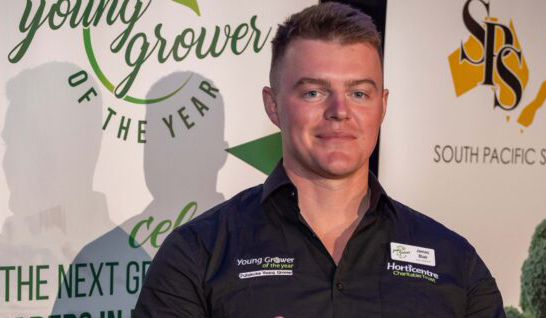
Agronomist James Blair grew up on a United Kingdom dairy farm and says working in the potato growing industry has some similarities to working with livestock.
“People often say that potatoes are the most similar crop to livestock farming because you have to be constantly checking and are very aware of how much you are dealing with a living thing,” says James, who works as a technical support for AS Wilcox.
“That’s one of the many things that makes potato growing so interesting, along with the versatility of the potato, with so many different varieties and uses.
“Potatoes are packed full of nutrients, and for the consumer they are good value for money in terms of what you get. Then there is the sustainability side. It’s a high yielding crop which requires much less water to grow than something like rice and there are new varieties which require less nitrogen and less water.”
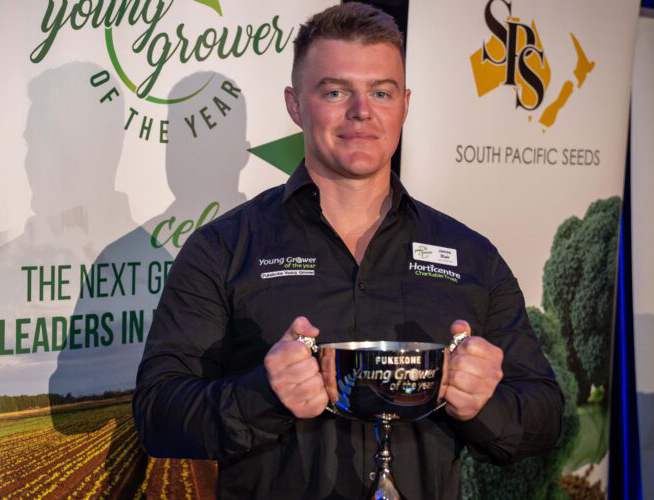
In May, the 28 year old won the Pukekohe Young Grower of the Year title and will be competing in Horticulture New Zealand’s national Young Grower of the Year competition in Cromwell in August.
Horticulture – or farming – wasn’t on his career plan when he headed to university in the United Kingdom to study for a degree in agricultural crop science.
However, having arranged to spend time with an agronomy company, Agrovista, he was soon hooked.
He joined that business once he graduated, working there for two years and gaining his BASIS diploma, which is required to be an agronomist in the United Kingdom.
Then he and his partner went travelling, working in Australia for a year before heading for New Zealand where he joined AS Wilcox, initially as a technical crop supervisor for potatoes.
He is now technical support for four regions, covering from Pukunui in the Far North to Ohakune, as well overseeing the seed programme for the South Island.
While walking the crops and working directly with growers is still his favourite part of the role, he says he enjoys the good mix of administration and practicality, and pursuing his absolute passion for agronomy.
“With New Zealand being a small country, I get to travel and deal with a lot of people. All the regions have different challenges, requiring different approaches.
“For all the crops, you have to have a very good understanding of the paddock, know its history, any pest issues, have a really good understanding of the nutrients and do in-depth soil testing. We build a plan from there.
“At AS Wilcox, we grow a lot of different varieties of potatoes, including Perlas and Piccolos. Small potatoes have very different nutrient requirements to bigger ones. Growing a small potato is very different to growing a crop of Agria or Vivaldi. We tailor everything from a crop to crop and paddock to paddock basis.”
James says he enjoys the trust his employers give him to try new things, and the wider innovation in the industry.
“There is constantly work underway on new varieties and targeting different markets and also real innovation in technology.
“Precision farming has been a really positive change. We have things like yield mapping now and the ability to electronically size potatoes has made a big difference.
“A challenge with potatoes is that you can’t see what you have but technology is coming where you will be able to scan part of a paddock and tell what is underground.”
The weather and getting timely access to modern crop protection tools are the main challenges he sees facing the sector, along with attracting and retaining new people.
“You are always striving for the perfect crop but with potatoes, you are always battling the weather.
“A challenge in New Zealand is around the time it takes for registration of modern pesticides and crop protection tools, and getting those onto the market here. It often feels like we are significantly behind the rest of the world in that.
With agronomy his “absolute passion”, James plans to stay it the field and continue to focus on improvements in technology and efficiency and he’s keen to promote the benefits of the sector to other young people.
“You do see a lot of turnover, for instance young people going to Australia. The industry has to be attractive and provide clear career pathways.
“I think a lot is down to good training opportunities, a good work environment and good role models – because if you are an ambitious young person, you see yourself progressing into other people’s positions, and if you see those people are passionate about the industry and enjoying what they are doing, it makes it much clearer.”